
Symmetry is a spectrum. In game design, it refers to how much one player’s turn mirrors another. Specifically, it refers to the levers they can pull.
Imagine a straight line. On the far left, we have perfectly symmetric games. On the far right we have asymmetric games. Let’s move along it from left to right.
Full Symmetry
On the far left of the line are perfectly symmetric games. Every player has the same knowledge, and there’s no state that affects those levers. This would be something like Zombie Dice, a simple push-your-luck game. On your turn, grab dice from the bucket and roll them, trying to collect as many brains as possible while avoiding headshots. Some dice are different colors (red are the most dangerous, green are the least). The first person to succesfully gain the required number of brains wins. Get 3 headshots on your turn, you lose all the brains from that turn. Otherwise, you can stop and bank what you have.

There is game state (like the number of banked brains, and how many headshots you have that turn), but at the start of each turn, everyone has the same levers they can pull.
I would also put games like Monopoly in this category, as your position on the baord doesn’t change the options available to you.
Symmetric With State
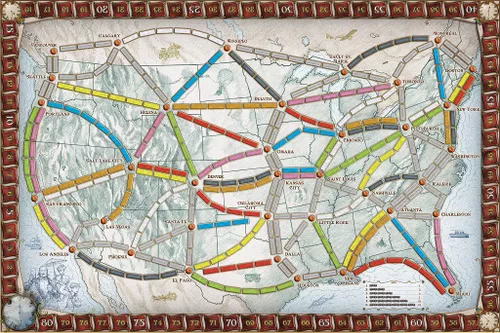
One step to the right of this is games where the levers are the same, but state can change those levers. Thse are games like Ticket to Ride or Scrabble. In Ticket to Ride, you can either draw train cards, play train cards to build a route, or draw new destination cards. But the state of train cards in your hand dictates what routes you can build. So while eveyone has the same levers they can pull, the state of the game changes how those levers can be pulled. One player may be able to build a route that is inaccessible to another based on how many cards they currently have.
Similarly, in Scrabble everyone has the same two options: play a word on the board or exchange tiles. But the words you are able to play with AETINNX are very different than what I can play with MIIOJSR.
All of the above games are very legible. No one will ever pull off a move that requires reaching for the rulebook to explain how what they did was legal. Each turns looks very similar to the one before it, and will look similar to the one that comes after.
Roleplaying Games
Many RPGs have classes. Theoretically, these classes do different things, but the level of asymmetry changes.
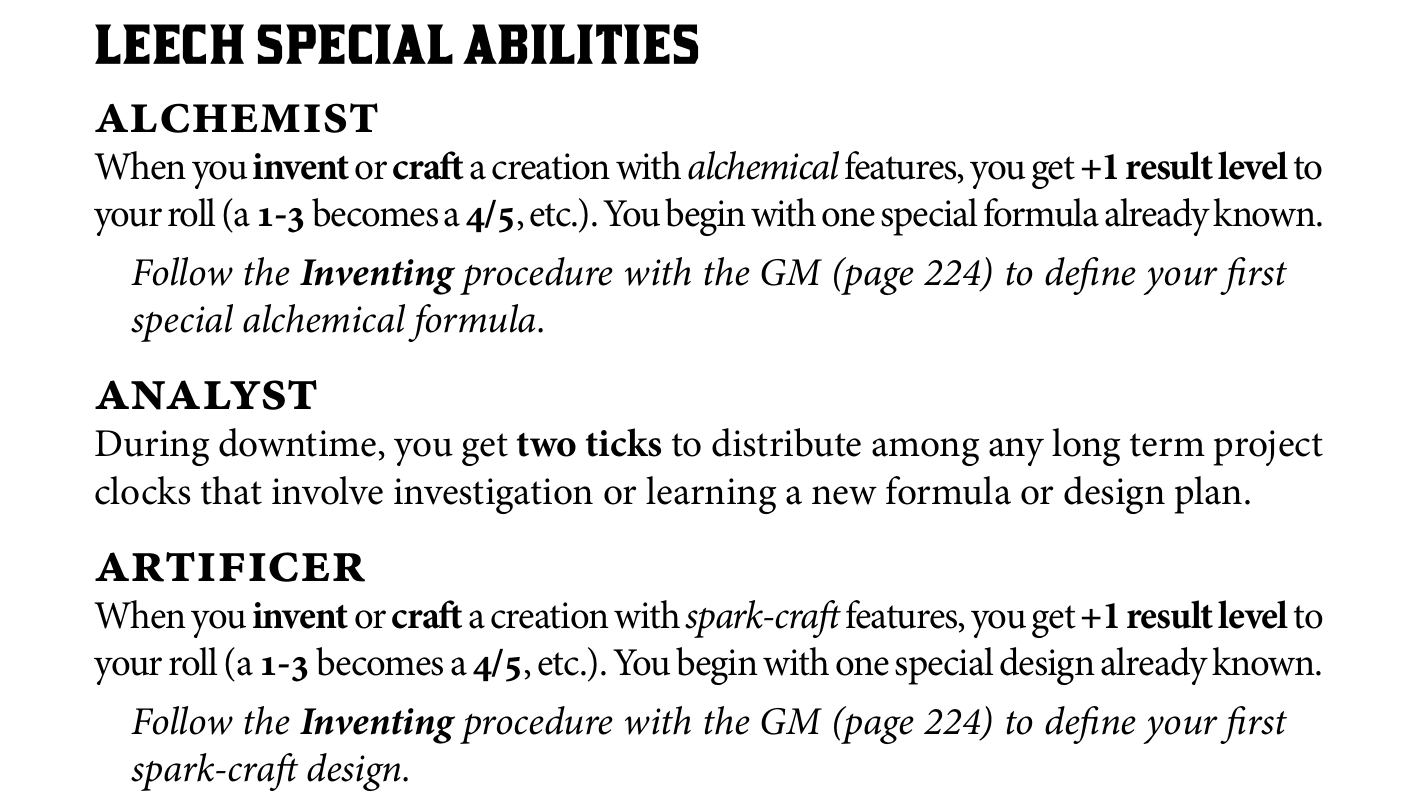
Take Blades in the Dark. Every class (“playbook”) has the same actions they can take during play, but they have different resources and abilities that are unique to their playbook.
Asymmetric Symmetry
Moving every so slightly more right, you have something like HEDGE, a game I adore. In HEDGE, each Warden has the same three abilties (Might, Slight, and Bright) as all the rest. But they also have their own unique resource that are gained and spent in different ways.
The Starless Knight gains Dread when it kills foes, and spends it to add Harm to its allies’ attacks. No one else can gain or spend Dread. The Briarbound Torch gains Blaze when it heals, and spends it to shield its allies from Harm. No other warden can gain or spend Blaze.
Each playbook is structured in the same way: it has a score for Might, Slight, and Bright. It has starting Health and Fate, and it has its own resource that it gains and spends in different ways. No player needs to know the details of the other players’ playbooks, but they recognize the format of it. We’re all playing the same game.
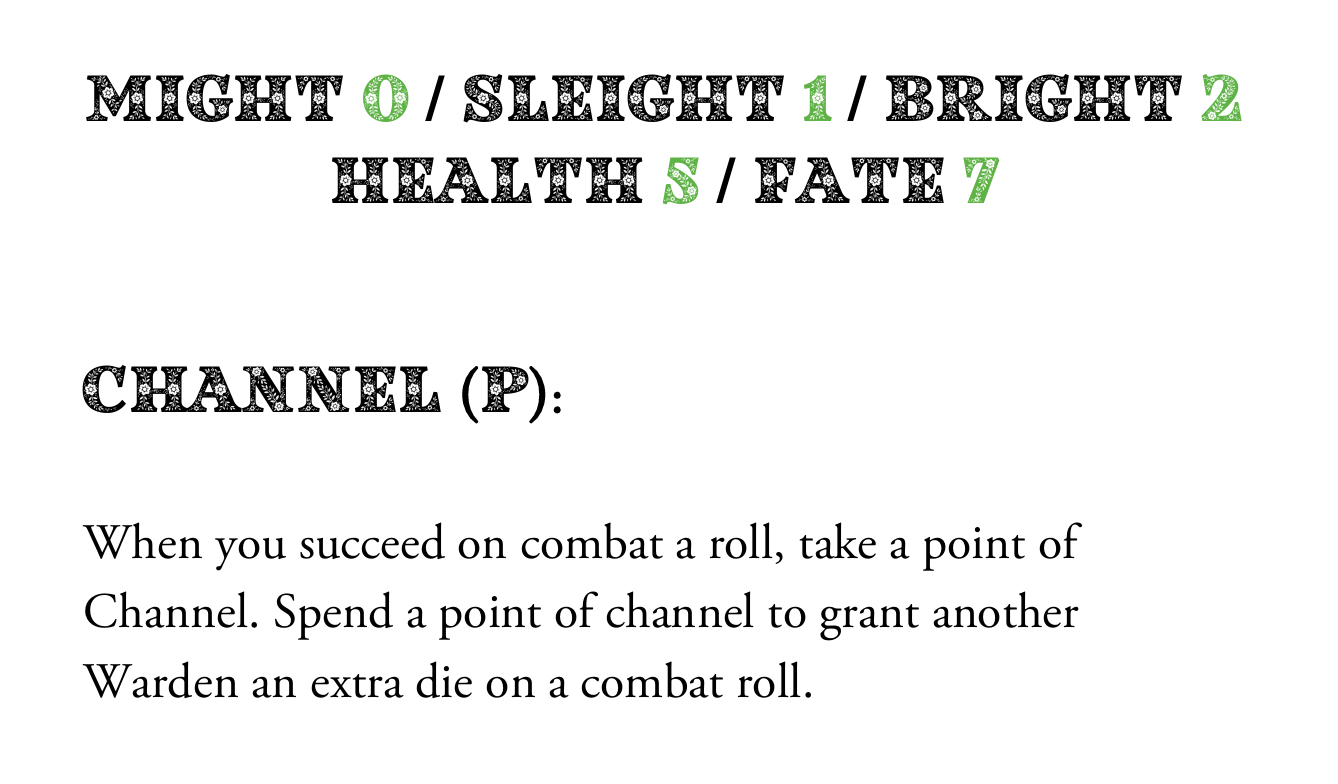
For me, this is the sweet spot. It’s easy to keep track of what everyone else is doing, but every class feels unique. I can express my unique ability in terms of how I gain it and how I spend it, and my friends can perfectly understand the scope of it. Making a new class in this space is fairly easy, assuming you can find space for it. Like a blank space on the periodic table, it’s easy to imagine the shape of the thing that would go here.
Balance is easy, classes are legible, and communication is quick.
But we can go further.
Symmetric Asymmetry
The next spot on our journey rightwards leads us to Spencer Cambpell’s Slayers, a game I’ve relesaed many adventures for.
In this game, each Slayer is playing its own minigame. The Gunslinger has 6 d6s that it spends and reloads. The Blade rolls a single d6, but combos, rolling another until it misses. The Arcanist chooses a spell, then rolls a d6 to see if it goes off.
All of these classes have one thing in common1 they roll d6s and are trying to get a 4+. Each player is essentially playing their own game. It’s not obvious at a glance what the player next to you is doing, or what the significance of their roll is. The Arcanist gathers Corruption over time, and the Blade might be going for a second attack when other players think their done.
The design spaces of these classes is fairly small (each class fits on just a couple pages). But there’s still a potential source of confusion.
That said, the design space is fairly unconstrained: anything can be a Slayers class! It just needs to be able to hit on a 4+.
Full Asymmetry
Then there’s Root.
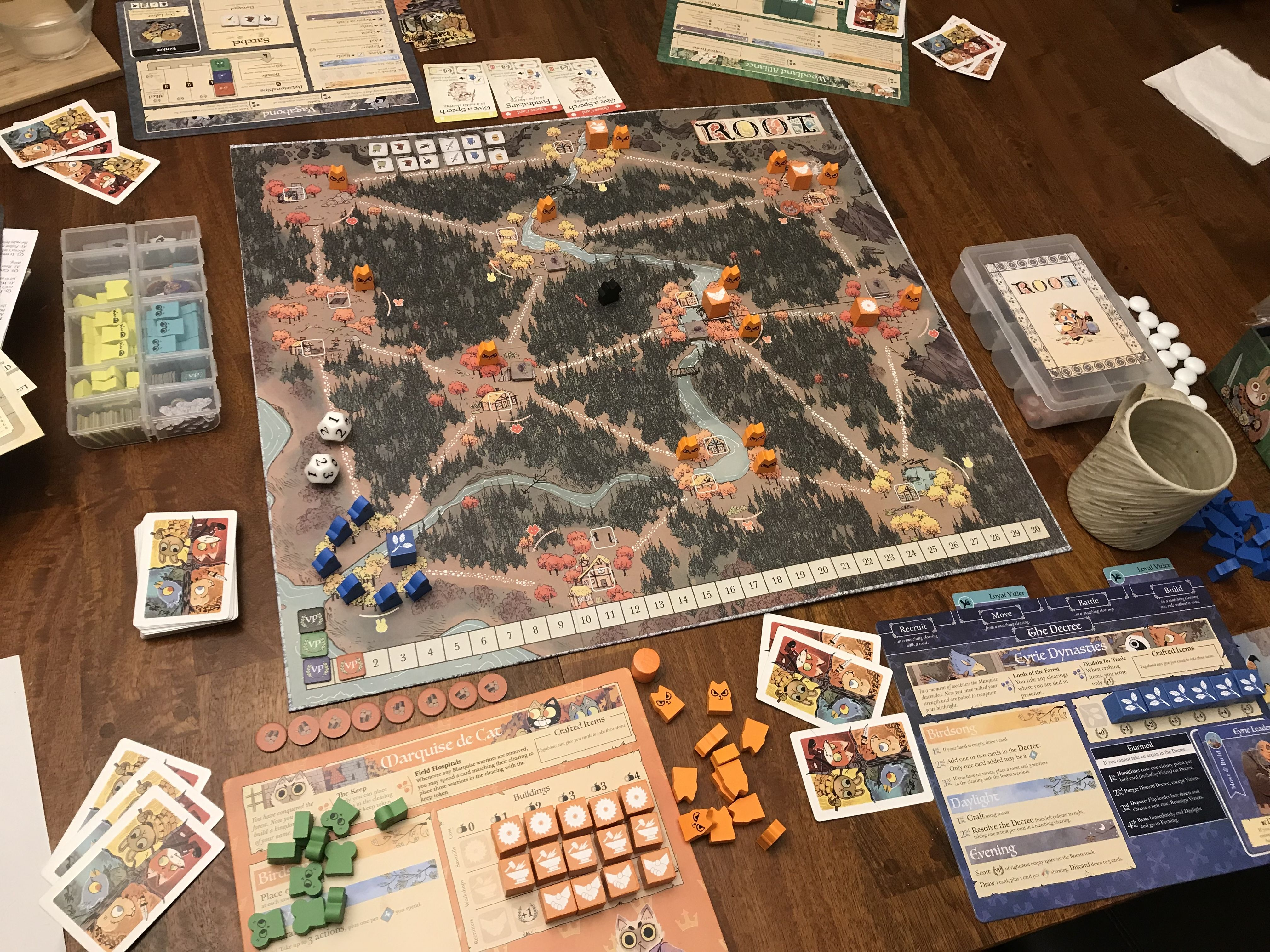
Root is a fully asymmetric game. The faction playing the birds is building a push-your-luck deck of cards2 empire, while the Cat constructs buildings in every open space. The Raccoon player runs around selling goods to other players, and will easily win if people don’t realize he can be attacked.
Expansions add more complexity, and more confusion. One faction dies and adds sympathy tokens to the board, springing up unexpectly with little notice.
Each faction is so separated from the rest, both spacially and mechanically, that it really does feel like you’re all playing different games. Oftentimes one faction will win and other players will say, “Wait, what just happened?” until they play again, armed with this new knowledge.
This isn’t a bad thing! At the time of writing, Root is the 34th most popular game of all time on BoardGameGeek!3
But full asymmetry means that there is a legibility cost, and in an RPG that can lead to confusion.
Conclusion
Symmetry isn’t inherently good or bad. It reduces cognitive load, and makes balance easy. Asymmetry introduces options, but can risk leaving players scratching their heads, or zoning out as someone executes a move they don’t have enough context to understand.
It can also rule! I’ve played in more than one game of Masks where someone playing the Doomed reveals a few games in that they are, well, doomed, and every time it’s a memorable moment for the table. I knew we were playing slightly different games here, but I didn’t realize THAT was on the table!
Asymmetry can also be a fun selling point! It’s what appealed to me about Slayers, which is the game that brought me back into game design after a 5-year hiatus. Like everything else, it’s a tool to be wielded with thought and care.
-
Many fan-made classes, including some I’ve made, play with this notion, and have Slayers rolling piles of d4s, or other dice other than d6. ↩
-
In the sense that it’s doomed to collapse, not a literal deck of cards. ↩
-
A platform that favors games that are new and complex. Root releasing in 2018 is a testament to its staying power. Of the 33 games above it, only two (Twilight Struggle, 2005, Brass: Lancashire, 2007) is older than 15 years4 ↩
-
The natural counter-argument is that maybe better games are being released all the time, and it’s not a recency bias at all! I won’t debate it here. ↩