

I spoke to Jason Cordova, creator of Brindlewood Bay and The Between about Public Access, the analog horror RPG that is Kickstarting right now!
Edited and adapted from conversation on 2-14-26.
Alex: Today I’m talking to Jason Cordova, who is best known for The Gauntlet, producing games like Brindlewood Bay, The Between, and Public Access, which we’re going to talk about more today. Am I forgetting anything in that introduction?
Jason: Thanks for having me.Those are the big games that I’ve written. I’m also a podcaster [for Fear of a Black Dragon], and I also publish the Trophy RPG. I’m not the writer of that, but I publish it.
Alex: Brindlewood Bay made a big splash because of its approach to investigation games, and that Carved from Brindlewood approach has been very popular. It is the backbone for the other two games, The Between and Public Access. So that Carved from Brindlewood framework is very popular for mystery games. Can you tell me what that framework is, and how you came to that approach?
Jason: Yeah. “Carved from Brindlewood” encompasses, at this point, a number of things. But probably most prominently is the way that it does mysteries and investigations, right? The idea is that, in these games, your characters are going to be collecting clues in order to solve mysteries. Usually they have some kind of question they have to answer.
In the case of Brindlewood Bay, the question is always the same: who did the murder? But in The Between, you can have questions that are much more varied, like: is this tiny vampire actually young, or are they an old person who’s just a small vampire? Or where is the lair of the killer? That kind of thing.
So you’ll be collecting these clues in order to answer the question. But importantly, once you have enough clues and you’re ready to answer the question, there is no canonical solution that the Keeper — which is what we call the GM in these games — has. The solution comes from the players.
The players will be looking at all their clues, and they’ll have a discussion. And indeed, they will engage in a certain type of deduction where, based on the clues they have, they have to come up with a solution that makes sense both for the story and also logically.
Once everyone is satisfied with the answer, there is a little formula for rolling dice. Depending on how many clues you’re able to incorporate into your theory, you get certain bonuses. You roll your dice to see if you’re correct. If you are correct, you can then pursue the opportunity associated with that question, which is usually to take down the bad guy.
Alex: If there is no canonical solution, what does a mystery or adventure look like in this system?
Jason: So these systems are modular in the sense that they have scenarios that they come with. Each game has eight or so that they come with, and then there are lots of expansions and things for them.
But the scenarios are not long, prose texts like you might find in, say, an old-school adventure module or something like that. I like to call them a sort of “toy box” approach to a scenario. You are given a collection of interesting characters, interesting locations, a bunch of clues to pick from, and other helpful things for the Keeper. Descriptive [elements] that you can pepper in wherever, dangers, that kind of thing.
You’re given all the components of the scenario, but they’re not presented in any particular order. So it’s up to the Keeper, at any given moment as the conversation is happening with the players, to decide, “Okay, I’m going to use this thing here because that makes sense.” It’s kind of a grab-bag way of running the scenario.
I’ve heard it described as a “deconstructed module,” which I think is a good way of describing what the mysteries in these games are. It’s all the elements, but they can be used as you need them.
Alex: And how do you get to this approach from a design point of view?
Jason: There’s a really direct line, actually, to how I got here. Before I was a game publisher or a game designer, I mostly was just running games for The Gauntlet. The Gauntlet was originally essentially just an online game calendar with a community attached to it, and we were running, I would say at that time, from around 2015 to 2018 or so, we were running dozens of different games every month.
When I was running games, I always wanted a way to prep a little more ably and quickly, without having to write a lot of notes or do a lot of reading. So I came up with this technique that I called 7-3-1. Some people still follow it to this day, even though I’ve kind of moved on from it.
The idea behind 7-3-1 was that, to prepare each session, I would come up with seven things — either seven places or seven characters. I would give each of those things three distinctive descriptive features, something I could describe at the table. Then I would give each of them one thing I could roleplay at the table.
In the case of a character, I would make a note about how they sound or maybe something they say, that kind of thing. And so I would do this 7-3-1 thing before any session I ran, essentially just a couple pages of quick notes, but notes with a purpose, a real intentional use for them. That style of GM prep is what I eventually adapted into the mystery and scenario structure of the Carved From Brindlewood games.
If you go and look at a Brindlewood Bay mystery, or a Public Access mystery, or an assignment for The Silt Verses roleplaying game — which we haven’t talked about, but that’s another game I co-wrote — you can see that in its DNA.
I mean, it’s more expansive than 7-3-1, but you can kind of see that that’s where it comes from. You can see the roughly seven things in each category, and you can see the three descriptive details. In the case of characters, there’s a single quote that you can roleplay. That’s where it came from. It’s just an adaptation of how I was prepping all my games.
Alex: And you’ve talked about this approach publicly before?
Jason: Yeah, we talked about it a fair amount on the old Gauntlet podcast. I mean this is real old Gauntlet religion, right. It’s not really a current thing anymore. It was a pretty simple technique, and a lot of people really loved it.
There’s a certain type of GM — and I am one such GM — who doesn’t want to do a ton of prep, I’m not a prep-heavy GM, but I also don’t want to go in cold. I am not one of those GMs who can just sit down cold and run the session, right? I have to have done a little bit of preparation, and so it was a good middle place.
And indeed, when you’re running a Carved From Brindlewood game, it has that feeling. It’s a sort of middle prep. You’re not having to read a big long module, but you’re also not sitting down to nothing. It takes about ten minutes to read through a scenario, and then I usually spend another ten or fifteen minutes kind of marinating in it and thinking of ideas. Then I’m ready to go.
Alex: I have one more question before we move on to Public Access. Brindlewood Bay is murder, The Between is more supernatural. Are there also mechanical differences between these systems?
Jason: The biggest difference, I think, between Brindlewood Bay and The Between — there’s actually kind of a funny history there that’s maybe worth mentioning — is that The Between actually came first.
That was the first game I was working on, and I had written all these playbooks. At that time, it was much more strictly a Powered by the Apocalypse game. I knew that I wanted to have this sort of abstract mystery system, this organic mystery system. I knew I wanted something like that, inspired quite a lot by other games that were out in the world, like Lovecraftesque by Becky Annison and Josh Fox and Psi*Run by Meg Baker.
So I knew what I wanted, but the problem was I had written all these playbooks for The Between, and that’s a lot of work. I didn’t want to have to reinvent the wheel if my mystery system didn’t work. I didn’t want to have to rewrite stuff a bunch until I got that part right.
So I set out to write what I considered to be a smaller, shorter game for the express purpose of testing out the mystery system. And that’s where Brindlewood Bay comes from. Brindlewood Bay does not have playbooks. It has just a common character sheet that every player uses, and it’s smaller in scope in terms of the world and the kinds of things the old women get up to.
I’m assuming people know what Brindlewood Bay is, but if not, it’s a game about elderly women solving murder mysteries in their town, and there’s an occult conspiracy behind it. I like to say it’s Murder, She Wrote meets H. P. Lovecraft: “Cthulhu, She Wrote.”
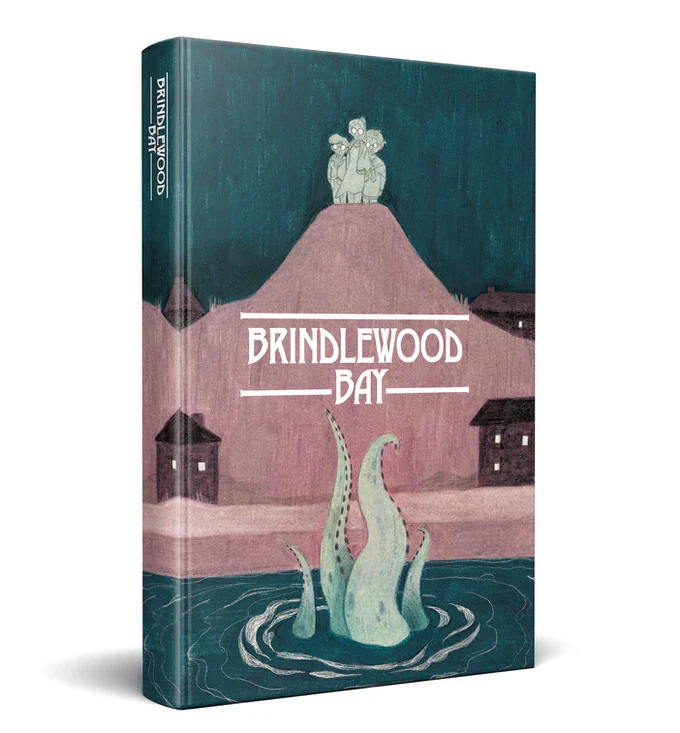
James: It was originally a small-scope, almost sketch project to try out the proposed mystery system for The Between. It just so happens that Brindlewood Bay was a big hit. In some sense, Brindlewood Bay was a little bit of an accident, because I never intended for it to be the big game. I intended for The Between to be the big one. But Brindlewood Bay was a big hit, and so that’s great.
All that is to say that these two games have always been in communication with each other. Once Brindlewood Bay came out, I took a lot of the learning from that and put it into The Between. Then, once The Between was coming out in its digital form, we took some lessons from that and put them into the Kickstarter version of Brindlewood Bay. All the games are like that, Public Access is in communication with these games as well, as are Silt Verses and so are our other in-development projects. That’s just kind of how we do things.
I guess the big mechanical difference between the two is the fact that, yes, they’re different types of mystery. One is a murder mystery, and one is monster hunting. Also, importantly, as I’ve noted, the Murder Mavens — the characters you play in Brindlewood Bay — use a single common character sheet. There aren’t individual types of Murder Mavens. You get to personalize them, but it’s a common character sheet sheet. Whereas The Between is playbook-based.
There are also some structural differences. The Between has a day–night phase cycle, which influences things. All in all, The Between is a more complex game. I don’t think either of them are complex, but it’s a more complex game than Brindlewood Bay.
Public Access
Alex: You mentioned Public Access, which is the reason we’re talking today. What is Public Access?
Jason: Public Access is a Carved From Brindlewood game about a group of young people in the year 2004. They’re twenty‑year‑olds in 2004 — which, I’ll note, is how old I was in 2004. It’s about a group of young people in 2004 who travel to this remote town called Deep Lake, New Mexico. They’re there to investigate the disappearance of a public access TV station that they remember as children, but that no one else remembers.
Now, the reason why they got onto this is because they all met on a forum and decided, “Hey, let’s go back to our hometown and see if we can figure out what happened to this TV station that no one else remembers.” So they get there in order to investigate the disappearance of this TV station called TV Odyssey.
But when they get there, while they’re trying to figure out what happened to TV Odyssey, they also encounter other mysteries taking place in and around Deep Lake. Deep Lake is a locus of lots of strange, cosmic, weird, scary things going on in this little part of the desert. They get wrapped up in these other mysteries, but all of it ultimately leads to what happened to TV Odyssey at the end.
Alex: Public Access has been described as an analog horror game. Can you talk about some of your inspirations there?
Jason: People reading what I just said might have picked up on the setup being very, very similar to the creepypasta story Candle Cove. If you know Candle Cove, it’s a similar kind of story: a bunch of people on a forum talking about a kids’ TV show that nobody else remembers.
That was sort of the initial inspiration, as far as that part of it goes. The analog horror part of it is related to the idea that there is evidence that this TV station existed in the form of these videotapes called the Odyssey Tapes. The characters are trying to find Odyssey Tapes in order to watch these episodes of this weird TV station, the different shows, and then find clues within those weird episodes to give them a hint at what happened to TV Odyssey itself. That’s the analog‑horror part of it.
But the inspirations were not just analog horror. It was also creepypastas, urban legends. It takes a lot of influence from things like the V/H/S horror movie series, and Blair Witch, and things like that. So it’s swimming in a lot of those early‑2000s internet‑horror things. That’s very much where it lives.
Alex: And are there mechanical differences between the system and The Between and Brindlewood Bay, as well? You mentioned they’re in conversation with each other.
Jason: They are indeed. In a lot of ways, Public Access is an interesting blend of the two. In terms of its scope, it’s a lot closer to Brindlewood Bay, but it has the day/night phase structure of The Between.
Probably the most distinctive difference of Public Access is that you will periodically “watch” an Odyssey Tape that the characters find. The way this works is: you’re doing your mysteries, you’re engaging in a lot of weird, horror‑soaked nostalgia, and occasionally you find an Odyssey Tape.
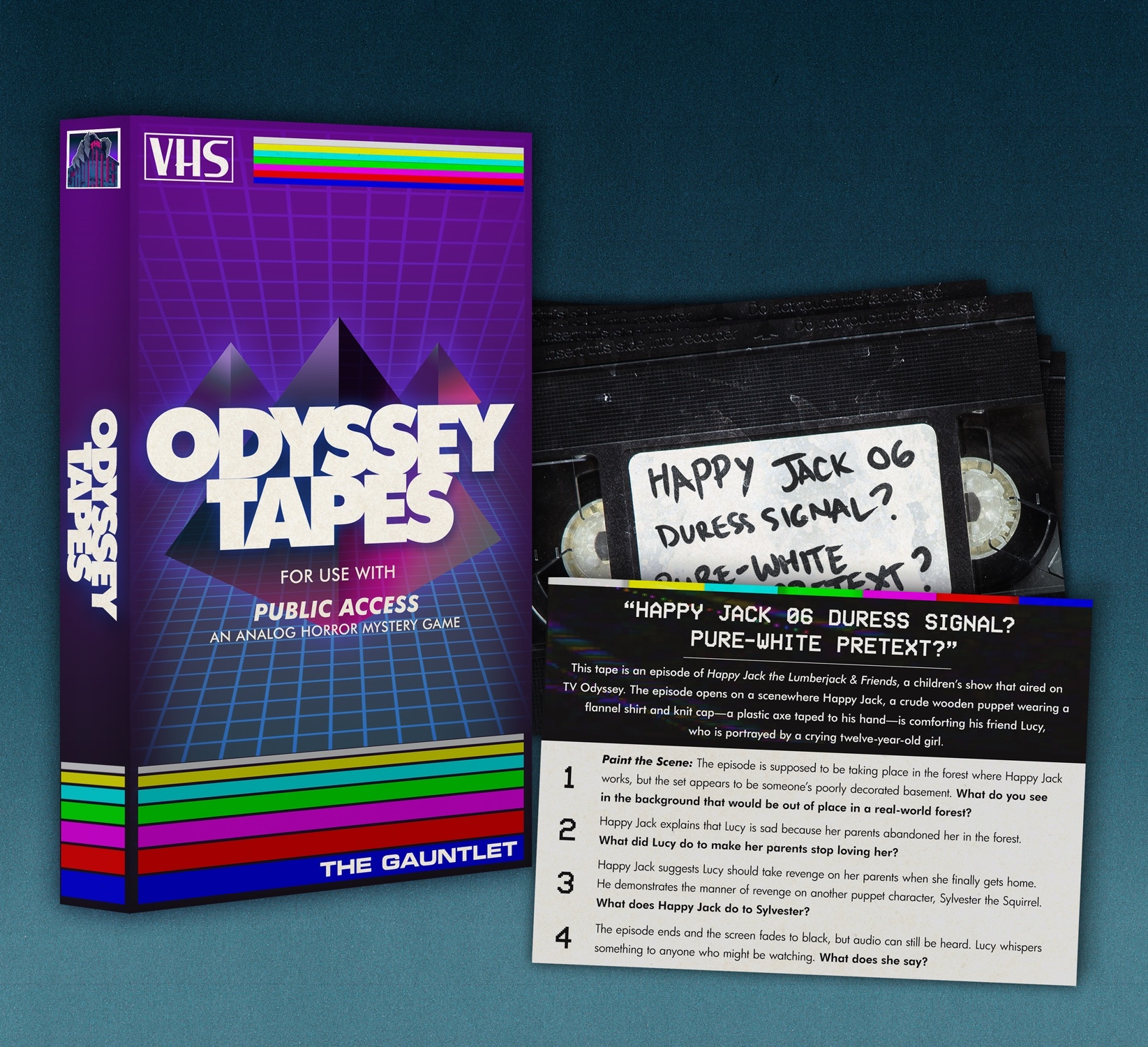
In order to “watch” it, each tape is essentially four narrative prompts that describe the episode of the TV show. Every player is assigned part of one of the prompts, and together you’re telling a little story about what we see in this episode of the show. You get to have a little “around the digital campfire” story that you tell each other.
So that’s a major difference with it, is that process of watching the Odyssey Tapes. And in this newer edition of Public Access, which is what we’re going to be Kickstarting here pretty soon, that actually has a direct connection to finding clues for the TV Odyssey mystery
Alex: You mentioned the Kickstarter, which is active now. Public Access has been out digitally, it’s been digital only for several years at this point, and now you’re bringing it to Kickstarter. Why physical editions, and why now?
Jason: Well, we were always going to at some point. I guess the way we do things is we let everything have a really long digital life, like multiple years, before we go to crowdfunding and physical editions.
The reason why we do that is because I like to spend as much time as possible playing the games and getting other people to play the games before we take the big, expensive step of actually printing a book. By the time we go to crowdfunding, we’re going to crowdfund the ultimate version of the game — the game that exists after we’ve had all this time to play it, learn about it, figure out what works really great, and what to emphasize, what to change. In some sense, the digital‑only release is like a very, very highly polished beta: very playable and a done game, but you can always improve it.
That’s what we’ve done with all the games: with Trophy, with Brindlewood Bay, with The Between. The one we’ve taken to crowdfunding is the best final version — essentially a second edition, but we don’t call it a second edition. So we were always going to do that. That’s always the plan, and now is the time.
> By the time we go to crowdfunding, we’re going to crowdfund the ultimate version of the game, the game that exists after we’ve had all this time to play it, learn about it, figure out what works really great, emphasize, and what to change. In some sense, the digital‑only release is like a highly polished beta.
The reason why now… there are a couple of things. It was next in line, and my plan was to launch the Kickstarter as soon as The Between was off to the printers, because once The Between is off to the printers, I have literally nothing else to do with it. I’m done with it, and I can totally focus on Public Access.
We’re actually going to be launching the Kickstarter a little bit before The Between goes to the printers, because there is something1 that is forcing my hand. I’ll have to bump it up the calendar for reasons that will make sense when that thing happens.
But we were always going to launch it in the late spring or summer, so we’re just a little bit ahead of the curve. That’s it. Basically, Public Access is ready.
About a year ago, we put out this alternate ruleset called the Skinny Jeans Edition. The Skinny Jeans were some things I wanted to playtest specifically in anticipation of this new edition. So we had all this time to play the base game, then about a year with the Skinny Jeans playtest, and now I’ve taken the base game and the Skinny Jeans playtest and combined them into this sort of ultimate final edition of the game that’s going to Kickstarter.
Alex: And in this ultimate polished, “not a second edition”, how much has it changed from the PDF that first came out?
Jason: If I’m being honest, not dramatically. The biggest change is that in the old edition, the connection to TV Odyssey always felt a little indirect. We know the characters are there to investigate this TV station, but then they run into all these other mysteries, and the campaign kind of became about all these other mysteries. At some point — because of the way the campaign is structured — you do have to go deal with TV Odyssey, but it never quite felt like a focus, it was always something that got pushed to the background until you were ready to go do it, or until it was time to go do it.
In this new edition, the biggest change is that TV Odyssey is front and center. Even as you’re doing the other mysteries, even when you’re watching the Odyssey Tapes, everything is always pointing back to TV Odyssey.
So when you go to answer a question for a mystery — a mystery that seemingly has no connection to TV Odyssey, just another weird thing going on in town — there is a way that, if you get a certain result on your roll, the answer to the question also connects to TV Odyssey.
You just get this much more tightly connected, focused thing with TV Odyssey at the center of it. That’s the biggest change by far. It’s a great change. I love the original edition, and I played the heck out of the original edition, but this new one really feels like the game I always wanted to make. I’m very happy with that.
Alex: What all are you Kickstarting?
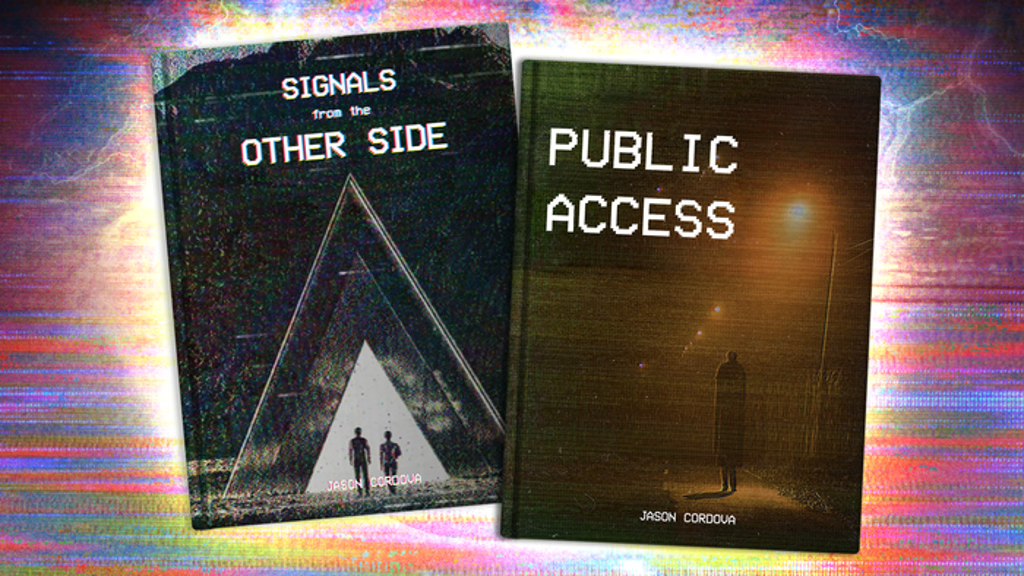
Jason: So, there is going to be this new edition of the game, this core book. There will be a second book you can get called Signals from the Other Side. Because the game has had such a long digital life, that’s given us a lot of time to write new mysteries, and we’ve got a bunch of brand new mysteries to put into Signals from the Other Side.
Signals from the Other Side will also have a new type of mystery called a Lost Transmission. A Lost Transmission is like a little side mystery that tells a prologue story, essentially. There will be some Lost Transmissions in that book as well, which is just another way of expanding the world and expanding your campaign.
It will also have a more in‑depth treatment of this aspect of the setting called the Chromatic Desert, which I’ll maybe save for people to explore on their own. But that’s the idea. It’s the kind of stuff I wanted to put in the original edition but didn’t really have a place for. And now I will.
We are also looking at having some Odyssey Tape cards. I mentioned those Odyssey Tape scenes where you narrate the tape. You don’t need the cards , you can print them out digitally or whatever, but these cards will have each tape on a card, and they’ll be presented in a VHS clamshell box. The clamshell will match the description of the Odyssey Tape clamshell boxes in the game. That’s another fun add‑on we’ll have.
Alex: And what if I inherited fortunes from a mysterious, deceased relative? Will there be a deluxe tier?
Jason: There might be! In our past crowdfundings, we’ve had higher‑level tiers where one of the excellent GMs from our community will run the game for you. Or, if you really want to kick in a good sum of money, I will come run a whole campaign for you. Those have always been kind of pricey tiers.
I have determined that my time to run a whole campaign is $8,000, and sadly no one’s ever bought one. I’ve never sold that. I’ve gotten close a couple of times. We have sold some of the middle‑higher tiers, but never that ultimate big tier. I’ll put it up again this time. Maybe somebody will jump on it and buy me a nice little vacation in exchange for running Public Access for them, because I need it.
Public Access is on Kickstarter now.
-
The Quinns Quest review of Public Access ↩