

I spoke to René-Pier Deshaies about Breathless (currently on Kickstarter!), what it means to be "Rules-bright", staying inspired, and building tools that give back to the community. The below is edited from a conversation on April 9, 2026.
Alex: You wear a lot of hats in the RPG world. Can you tell me a little bit about the various roles that you play in this space?
RP: I run Fari RPGs, which is like an indie design studio. That's the brand that I use to publish tabletop role-playing games. I also love making system reference documents of my games, which are kind of like open-licensed versions of the systems that I develop, so I publish those online so that people can make their own games based on the rules that I've battle-tested.
Apart from that, I also maintain various web tools, like web applications. I'm a software engineer during the day, so I use those skills to help the TTRPG community in various ways. I've published a website called Keeper, which takes a bunch of open license content and SRDs and makes it accessible on the web in a nice format.
I also love to record tutorials for the Affinity Publisher software, and also record interviews. Essentially, my brain is very fuzzy and it takes me to a bunch of different places. I cannot focus on one single thing at a time, so every time I get an idea I'm like, "Oh, I should do this," and then I invest a bunch of time and then forget about it for six months. So that's kind of what I do.
Alex: You are always sharing advice around how to do things in Affinity or design techniques that you like. Can you talk to me about that spirit of community, of giving back? With Fari, and building these SRD tools, where does that come from, that drive to build tools for other people?
RP: It's funny because I think it may be coming from the fact that, again, I'm a software engineer professionally, and a lot of the things that we do as software engineers rely on the shoulders of developers who created tools like 30, 40 years ago that we still heavily rely on today. Even MacOS would not exist without Linux and Unix at its core, and this core is free and open licensed. It has been powering servers around the world for decades now, and the fact that we can rely on these tools today makes technology truly a marvel.
If you take the same idea and apply it to TTRPGs, then you also create some sort of space that is welcoming and supportive. Instead of each creator being an adversary and being combative and competitive, it's all about, "Hey, I created this cool thing, you can use it. I use this license, which is essentially just give me attribution, just say that you loved that and it was inspired, just drop a link to my name or my website, and that's good enough for me." Using those things really makes for a more healthy community, and I think this is something that is very dear to me because, as a hobby, we really thrive a lot in that sort of environment.
Alex: Yeah. And I think I've seen you looking into building an Itch alternative. Is that something you're prepared to talk about?
[Editor's note: itch.io is an online marketplace commonly used to host and sell TTRPGs]
RP: [Laughs] Yeah, I can talk about it. This is the kind of thing where I got hyper-focused. The tech industry is absolute chaos nowadays, and I used to work for a company and they fired all the Canadians in my team, and I was part of that layoff. I got a couple of weeks of salary and I was like, "Well, what can I do?" So I focused a lot on TTRPG work while I was looking for new jobs.
Then I got the idea, "Well, maybe I can build my own alternative to Itch," because it was made for video games and not TTRPGs, and we kind of acted our way into this thing, and now there's a category called "physical games", which is kind of weird, but whatever. I bought the domains, created the app, and I still have all the code. It's working very well. I've got all the databases set up, the web servers, everything is ready to go.
But the main hurdles with creating a platform like that is, first of all, taxes. A platform like Itch or DriveThruRPG, you're not just selling a service to one person; you're selling a service to a person that then sells it to others, and you're considered a marketplace. From there, you enter the marketplace facilitators laws, and then it becomes really, really hard to manage. The tech side of things is solved, that's not a problem. It's the legal side of things. That's why I've been joking online, saying DriveThruRPG should just hire me and I'd redo their website in an afternoon.
Alex: It's always the bureaucracy that gets in the way. Zooming in on the games you make, getting closer to the reason we're talking today, I want to talk about Stoneburner, one of your recent big projects. What can you tell me about that?
RP: Stoneburner started off as a shower thought, where I had this idea of, "What if you were dwarves in space, and your great-grand half-uncle on your dead uncle's side has died, and you're the only person who can inherit his mines that are tied to it, like an asteroid belt, and those mines are infested with demons?" So the general idea of the game was sci-fantasy, where everyone's a dwarf, a space dwarf, and you have to mine an asteroid belt filled with demons.
That started off as a joke, and then I started working on a master page inside Affinity. I had a friend who started creating fan art for a game that didn't exist, and that art became the actual art of the game. Now the game kind of evolved out of those ideas. It's like a 120-page game based on the Breathless system, which was one of the first games that I released. It's all based around a dice degradation mechanic, where your skills are associated with a die rating, and every time you roll them, those dice step down, so you get more exhausted as you play and as you perform those challenging actions.
The only way for you to reset those ratings is to catch your breath. Pretty simple: you just say you catch your breath and all your skills are refilled. Great. But every time you do so, the GM gets to pull a strong move. They get a freebie of, "I can throw a complication into your face because you just decided to catch your breath." So there's this continuous cycle of tension and release, which was really great for Stoneburner.
I released the game two or three years ago on Kickstarter, and it got like 45,000 Canadian dollars at the time, and got a couple more on BackerKit. So it was a pretty big success for one of my first campaigns ever. But of course, the industry was a bit different than it is today.
Alex: You mentioned that you started with the master page in Affinity. Is that usually how you work, with a design-first approach?
RP: Yeah. I am not inspired in working in a note-taking application or Google Doc. I often need a little bit more to stay inspired. I can jot down some notes when it's related to mechanics or things I want to test. I also love to write code to test scenarios and simulations of my game, so sometimes I'm going to write that inside a note-taking application.
But when I write a game, if I'm working in Google Docs, I'm going to get bored very quickly and not want to work on the game. One thing that I love doing is I'm either going to make a website for it and use nice fonts and nice art and nice layout, or I'm going to work directly inside a layout software, because that way I can create a nice master page and use nice fonts and paragraph styling and all that to keep myself inspired, versus just working with black text on a white background using Arial as a font. Working inside the layout helps me be motivated to work on a game for a long period of time.
Alex: I hear a lot of people decry working directly in layout, so it's interesting to hear you advocating for that approach.
Everyone has their own approach. There are obviously pros and cons to this approach. Of course, as you work inside your layout software, you're going to have to do a lot of reworking to make sure that things fit, and then you add a word and it breaks the layout. But for me, it's part of my workflow. This is what I love. I don't care about redoing my pages a bunch of times.
Of course, I'm not working in a 300-page document. That would be completely different. But when you work in layout, it also allows you to be a bit more creative. For example, I'm pretty sure Mörk Borg was created in layout. If it wasn't, I don't know what happened there. There's a way to stay inspired when you work there and to be a bit more creative, and this also forces you to rethink the way that you write and how things are placed, like information hierarchy. Pros and cons.
Alex: Okay, I've put it off long enough. The main reason we are here today is to talk about Breathless, which is currently on Kickstarter. But before we talk about that new edition, can you tell me what is Breathless?
RP: Breathless is a pamphlet-sized game that is a zombie survival horror game. It fits on one piece of paper that you can print at home, and it has everything you need to play the game. It has character creation, the rules, a nice cover, and a character sheet in one pamphlet. It's really made to be as accessible as possible. You don't know what to play tonight, you want to play some zombie survival horror one-shot, you just print that and you're ready to go.
It uses the same mechanics that I outlined earlier when talking about Stoneburner. I released it in 2022, and that was during the TTRPG Twitter era, and people got really excited about the game. So I decided to open license it, create an SRD out of it, release it for free, and organize a jam. Now, four years later, there's more than 300 published acts that I know of that are using the core mechanics that I developed for Breathless, and a hundred of those have been published in Japanese on a site called talto.cc. So that's Breathless in a nutshell. It's this little pamphlet game that really sparked the imagination of a lot of people.
Alex: And what is new in this edition?
RP: Last year Ray from Mythworks reached out. He is a big fan of Stoneburner, big fan of Breathless, and he offered to publish a new edition of Breathless, but really wanted to stay true to the community aspect of the original game, the pamphlet accessibility-focused aspects of the original game.
So this new edition really stays true to what made Breathless successful. It uses the STORYPAK format, which they use for their game CBR+PNK. It's going to be 12 pamphlets, four-fold pamphlets, inside one VHS-style box. Those pamphlets are the kind of thing where you could open the box and play right now.
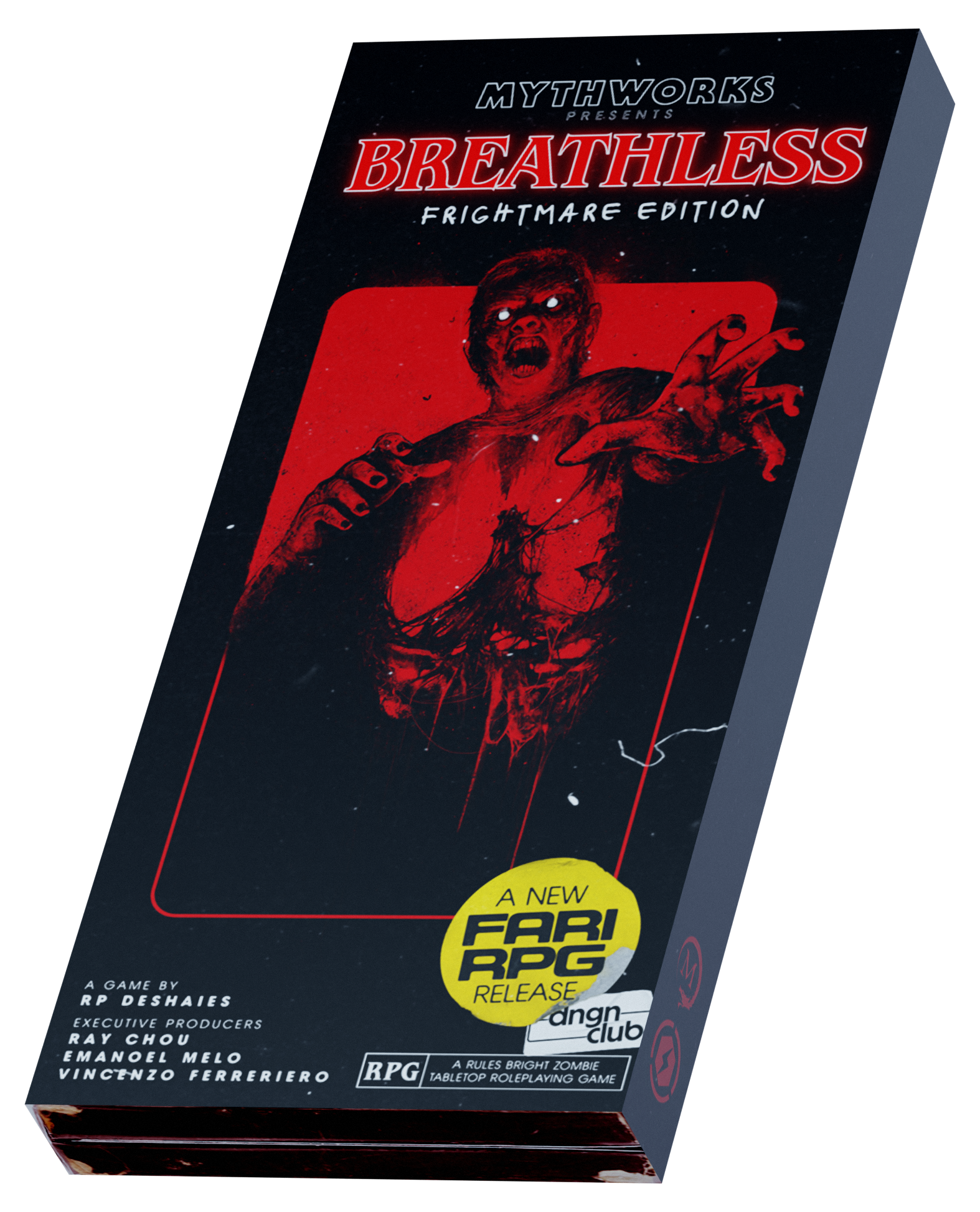
There are six pamphlets that are going to be for the players, which will include all the character creation rules, the core rules, as well as the character sheet. There's going to be four pamphlets' worth of adventures. There's going to be a pamphlet that's about new rules that I developed for going from one-shot to campaign play.
If you've watched or played The Last of Us, where Ellie and Joel go on a long journey, or if you've read The Walking Dead, where eventually Rick and his group find some sort of haven that they can stay in and want to protect as their resources dwindle, and they need to restore some of those resources, but by doing so, their other types resources dwindle down.
Those types of gameplay loops [are] what this additional pamphlet of rules will bring to the table: going through different phases of play like survival, journey, and haven. We have four adventures that will take you from one phase of play to the other so you can really get the full cycle of classic zombie media.
It's all laid out by Jack of the DNGN Club, so it's got this classic VHS retro aesthetic, which is pretty cool.
Alex: Who is this for? Is this just for people who love zombie games, people who like low-prep games? Who's your audience here?
RP: If you love things like The Walking Dead, The Last of Us, 28 Days Later, you're going to have a great time with Breathless. But also, if you want to play a game that will really bring you places and keep you on your toes and have a lot of tension while not overburdening you with rules, that's kind of the way I would phrase it.
I like to call those games "rules bright," as in it's not about crunch, it's not about being light on rules. It's just the right amount of rules to carry the theme that the setting and the game want to put into focus. This is a zombie survival horror game, so all the mechanics are there to create this cycle of tension and you getting more tired.
There are mechanics for looting, because looting is a big part of zombie games, but also item degradation mechanics. The items you use are going to be stressed, there's going to be wear and tear, and eventually those items will stop working. You're going to need to loot again, but when you loot, you may be finding a bump in the dark.
Alex: Did you coin "Rules bright?"
RP: I did! It was a tweet, and it got viral on Twitter.
Alex: Is there anything else you'd like to mention?
RP: One thing that's been very important for us for this Kickstarter was to really reinforce the fact that Breathless would not exist without its community. So what we did is we reached out to a bunch of creators that we deeply respect, that have made Breathless games in the past, and offered them to join in on the project.
Our stretch goals are essentially gifts. If we reach this stretch goal, we're going to pay this creator a royalty fee and give you a free copy of their Breathless game. So yes, you're going to get Breathless if you back the game, but as we hit those stretch goals, you'll also get Substratum Protocol from Pandion Games, you'll get The Facility from Galen Pejeau, you'll get Trespasser from Binary Star Games, and also Anomaly Hunters from Wendigo Workshop.
So a bunch of super cool Breathless games that you're just going to be filled with, so many games that are all about dice stepping down. That was something that I thought was very cool of Mythworks — they really understood what made Breathless special. It wasn't just about a fancy step-down dice mechanic; it was also about the community and everything that came out of it.
Another thing we've been thinking about, and this is a bit of a spoiler, is we're planning on organizing a third iteration of the Breathless Jam. There's already been two Breathless Jams, and we're planning on organizing a third one that will happen during the Kickstarter. It will last only a couple of weeks, it will be very short, but the goal will be to create material that is based on the rules or material that is compatible with the zombie game.
If you want to make an adventure, a supplement, or even a poem, you can do so. If you want to make your own game based on the original SRD, you can do that as well. To make the game even more accessible, I decided to revamp the original Breathless pamphlet with updated rules and new art and new layout, and publish it for free on Itch, so everyone can already get a sense of what we're trying to build there.